
For banks, reputation is no longer shaped only by advertising, branch experience, or word of mouth.
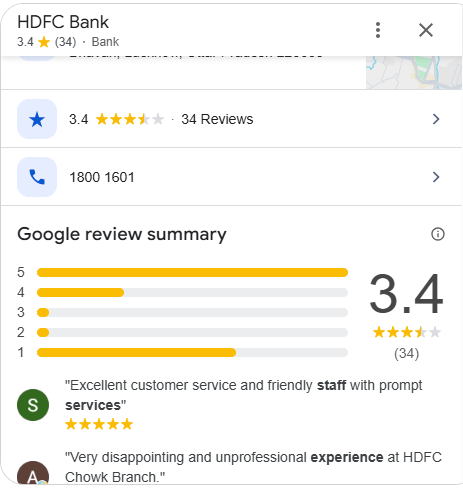
When a customer searches for a nearby bank branch on Google, the branch’s star rating, review count, review content, business information, and responses can all influence what the customer sees and how they evaluate the branch.
A few negative Google reviews may not seem significant on their own.
But when similar complaints repeatedly appear across a branch’s Google Business Profile, such as long waiting times, poor staff behaviour, unresolved service requests, ATM issues, or lack of follow-up, they can affect both customer trust and local search performance.
For banks like Kotak Mahindra, HDFC, Axis managing hundreds or thousands of branches and ATMs, this makes Google review management an important part of local reputation management and local SEO.
Why Google Reviews Matter for Bank Branch Visibility?
Google states that local search results are primarily influenced by relevance, distance, and prominence.
Prominence refers to how well-known a business is and can include factors such as the number of websites linking to it and the number of reviews it has. Google specifically notes that more reviews and positive ratings can help a business’s local ranking.
This doesn’t mean that a negative review automatically pushes a bank branch down in Google Search or Maps. Google does not publish a formula that says, for example, “one 1-star review equals X positions lost.”
Instead, Google reviews are one part of a broader local search ecosystem.
For a bank branch, a consistently weak review profile can therefore become a concern because it can:
- Lower the branch’s average rating
- Create a poor first impression in Google Search and Maps
- Highlight recurring service problems
- Influence customers comparing nearby branches
- Make the branch appear less trustworthy
- Reduce the effectiveness of other local marketing efforts
How Negative Reviews Affect a Bank Branch’s Local Visibility?
1. They Can Pull Down the Overall Star Rating
Google calculates a business’s review score as the average of all ratings published on Google. That makes every new review relevant to a branch’s overall rating.
Consider a branch with a 4.5-star rating and a steady flow of new 1- and 2-star reviews. Even if the branch has many positive reviews, a sustained pattern of poor ratings can gradually change the profile customers see.
For banks, this matters because customers often search for a branch before visiting it, particularly when choosing between several nearby locations.
2. Negative Reviews Can Influence Customer Decisions
Local search visibility is only one part of the equation. What customers see after clicking on a branch profile matters just as much.
Local Consumer Review Survey (2025) found that 81% of consumers use Google to find reviews of local businesses. The study also found that 74% of consumers use two or more websites when researching reviews.
The same research found that consumers increasingly look at the details of reviews, rather than simply the star rating. For a bank, that means a branch with several reviews mentioning:
“Long waiting time”
“No response from staff”
“Poor customer service”
“ATM not working”
may create a stronger negative impression than the rating alone suggests.
3. Repeated Complaints Can Shape a Branch’s Online Reputation
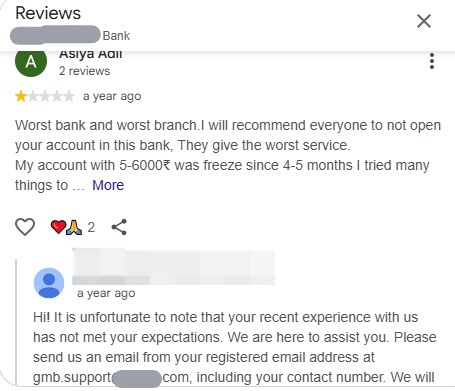
One negative review may represent an isolated incident. Ten Google reviews mentioning the same issue tell a different story. Suppose customers repeatedly complain about:
- Delayed account services
- Unresponsive branch staff
- ATM downtime
- Long queues
- Poor complaint resolution
- Difficult documentation processes
- Lack of follow-up
Potential customers may begin to associate those issues with the branch. This is particularly important for banks because customers are trusting branches with money, financial information, and important transactions.
A pattern of unresolved complaints can therefore carry more weight than an occasional negative comment.
4. Unanswered Negative Google Reviews Can Make the Problem Look Worse
A negative review doesn’t automatically mean a branch has a reputation crisis. Ignoring it can make the situation look worse.
A research in 2024, found that 88% of consumers said they would use a business that replies to all of its Google reviews, compared with 47% for businesses that don’t respond to reviews at all. The research covered local businesses broadly, not banks specifically.
A thoughtful response gives the bank an opportunity to show that:
- The complaint has been noticed
- The branch takes customer concerns seriously
- There is a process for resolving issues
- Customers can contact the appropriate team
For financial institutions, responses should also avoid revealing account information, transaction details, or other confidential customer information.
Also Read: How to Remove Negative Google Reviews? Tips and Suggestions
Negative Reviews Don’t Always Need to Be Removed
This is an important distinction in bank online reputation management. A genuine customer complaint cannot simply be deleted because the branch doesn’t like it.
Google says businesses can report reviews that violate its policies, but only reviews that violate Google’s policies are eligible for removal. A business should not report a review simply because it disagrees with it or considers it unfair.
Google prohibits fake engagement, paid Google reviews, rating manipulation, and several forms of inappropriate or misleading content. So, an effective ORM strategy has two different tracks:
Genuine Negative Review
Respond → Resolve → Learn → Improve → Encourage genuine feedback
Policy-Violating Review
Identify → Flag → Report → Monitor
This approach is much safer than trying to remove every negative comment.
How Banks Can Turn Negative Feedback Into Better Reviews?
The objective shouldn’t be to make negative Google reviews disappear. The objective should be to improve the customer experience and create more opportunities for satisfied customers to share genuine feedback.
1. Respond Quickly
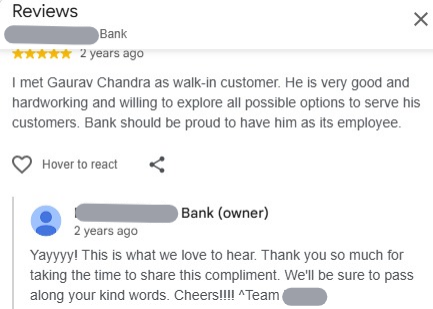
Branches should have a defined process for monitoring new reviews and responding within a reasonable timeframe. A response can acknowledge the concern, provide an appropriate next step, and move sensitive conversations away from a public review thread.
2. Identify Recurring Issues
If 50 branches are receiving complaints about waiting times, while another 20 are receiving complaints about ATM availability, those patterns should not remain buried inside individual reviews. Review analytics can turn individual comments into branch-level and regional insights.
3. Resolve the Root Cause
ORM should connect with operations. If customers consistently complain about the same issue, the bank should investigate what is happening at the branch rather than simply responding to reviews.
4. Ask Satisfied Customers for Genuine Google Reviews
Banks can make it easier for customers with genuine experiences to leave feedback.
Google allows businesses to ask customers for reviews through a review link or QR code, provided the reviews reflect genuine experiences. Businesses should not offer incentives or selectively solicit only positive reviews.
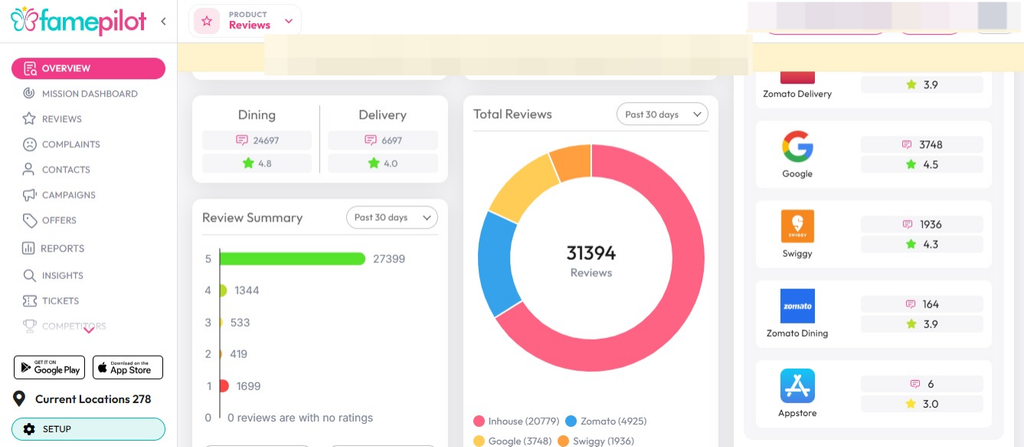
How Famepilot Can Help Banks Improve Google Reviews and Manage Negative ORM?
For banks with multiple branches and ATMs, managing Google reviews manually can quickly become difficult. A centralized bank reputation management platform can help teams monitor branch-level feedback, identify recurring problems, respond consistently, and build a stronger review profile.
Famepilot brings these activities into one platform.
1. Monitor Reviews Across Every Branch
Famepilot’s Review Management platform gives banks a centralized view of customer reviews across locations and platforms. Teams can filter feedback by:
- Location
- Rating
- Source
- Sentiment
This makes it easier to identify branches receiving a high volume of negative feedback instead of waiting for individual branch managers to discover complaints themselves.
2. Respond to Reviews From One Dashboard
Instead of logging into individual branch profiles, teams can manage review responses through a centralized workflow. This helps banks maintain a consistent communication standard while still allowing responses to address the specific customer issue.
For negative Google reviews, teams can identify the complaint, coordinate internally where necessary, and respond professionally without exposing confidential customer information.
3. Generate More Genuine Customer Reviews
A bank’s reputation shouldn’t be defined by the small percentage of customers who decide to complain publicly.
Famepilot can help banks create structured review-generation campaigns through channels such as SMS, email, and WhatsApp, making it easier to request feedback from customers after genuine interactions.
The goal is not to manufacture positive reviews. It is to give satisfied customers a simple way to share their actual experience. This distinction is important because Google prohibits incentivized reviews and selectively soliciting only positive reviews.
4. Use Sentiment Analysis to Find Branches That Need Attention
A bank may have thousands of reviews across hundreds of locations. Reading every review manually is difficult. Famepilot’s sentiment and deep-insight capabilities can help teams identify common themes and understand where customer sentiment is deteriorating.
For example:
Region A: Staff behaviour complaints increasing
Region B: ATM availability complaints increasing
Region C: Strong positive sentiment
Region D: Response rate falling
This gives regional and central teams a clearer picture of where intervention may be required.
5. Convert Negative Feedback Into Service Tickets
A review shouldn’t always end with a public reply. If a customer raises a service-related concern, Famepilot’s Service Ticketing capability can help convert feedback into an actionable internal request.
For example:
Customer Review:
“Visited the branch three times for the same issue and still haven’t received an update.”
Internal Action:
Create service ticket → Assign to branch/team → Set priority → Track resolution → Follow up.
This connects online reputation management with actual customer service.
6. Identify Branches That Are Pulling Down the Bank’s Reputation
For a large banking network, the overall brand rating can hide significant differences between locations.
One branch may have a 4.7 rating while another sits at 3.1. Famepilot’s multi-location dashboard helps teams compare branch performance and identify locations that require attention.
This allows reputation teams to move from:
“Our bank’s rating is declining.”
to:
“These 15 branches are contributing most to the decline, and these are the issues customers are mentioning.”
That is a much more actionable approach.
From Negative ORM to a Healthier Branch Reputation
Negative Google Reviews are not something a bank can or should eliminate completely. Customers will occasionally have poor experiences. The better objective is to make sure those experiences are heard, addressed, and learned from, while satisfied customers also have an easy way to share genuine feedback.
A practical bank ORM cycle looks like this:
Monitor Reviews → Identify Negative Trends → Respond Quickly → Create Service Tickets → Resolve Issues → Request Genuine Feedback → Track Rating & Sentiment
Over time, this can help create a healthier review profile while giving bank teams better visibility into branch-level customer experience.
Final Thoughts
A bank branch’s Google reputation is more than a number beside its name. Google Reviews can influence how customers perceive the branch, while review signals such as rating and volume are also connected to Google’s concept of local prominence.
For banks managing large branch networks, the challenge is therefore not simply getting more 5-star Google reviews. It is building a repeatable system for monitoring customer feedback, resolving service problems, responding to reviews, reporting policy-violating content, and generating genuine customer feedback at scale.
That is where a platform such as Famepilot can fit into a bank’s broader local SEO and online reputation management strategy.
Book a FREE Demo – https://famepilot.com/product-demo/
Contact Us (form) – https://famepilot.com/contact-famepilot/
Have any queries or suggestions? Mail Us at [email protected]


